Financial Mathematics: Computational Approach
This book introduces the fundamentals of financial mathematics.
It begins with a discussion of simple and compound interest and then establishes the important concepts of effective and equivalent effective interest rates.
R 320.00
Basic Mathematics: a Revision Primer for Management Students
BASIC MATHEMATICS is aimed primarily at management students preparing to write the GMAT test which requires a strong foundation in fundamentals of mathematics. It is also of value to anyone wanting a general revision of basic mathematics.
The text focuses only on those areas of mathematics required for the GMAT test, consisting of four main topics: basic arithmetic; fundamental algebra; geometry and introductory statistics. After a brief review of each topic’s basic rules and methods, there is at least one worked example followed by an extensive set of self-practice exercises. The student should attempt as many exercises as is necessary to master the topic.
R 510.00
Media Ethics In The South African Context
The second edition of Media Ethics in the South African context explores the dynamic and potentially explosive field of media ethics from a South African perspective. Grounded in ethical theory, the public philosophies of communication and media performance norms, this text provides guidelines for the individual’s ethical decision making; for both media practitioners and media groups. Cutting edge analysis of the South African normative context under the previous and present political dispensations makes this book essential reading for media policy formulators and students alike. Changes in the normative context are presenting the South African news media in particular, with new challenges.
R 550.00
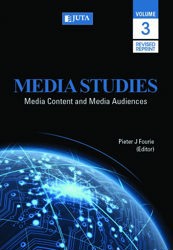
Media Studies Volume 3: Media Content And Audiences
In the third volume of this series, Media Studies, the emphasis is on media content and media audiences. Media content and media audiences (or users) are covered from methodological and theoretical perspectives. For the revised reprint of this volume, a new introduction has been included to highlight the relevance of the current content and to contextualise within it the content of Volume 4 Social (New) Media and Mediated Communication Today (2017).
R 840.00
Media Studies: Volume 2 – Policy, Management And Media Representation
In the second volume of the four-part textbook series on Media Studies the emphasis is again on the relationship between media and society. While further exploring media as an institution, this volume also introduces the topics of media regulation and content. Volume 2 is guided in part by the question: How do we control and manage the media? Communications policy is explained, with overviews of how the Southern African media is externally and internally regulated to ensure a well-organised and disciplined modern media system. Strategic ways of managing the media are discussed. The book deals with the concept of media representation: How does the media reflect and represent reality or its aspects? Is the news that is presented an accurate portrayal of reality? How does the media deal with identity, race, gender, sexual orientation, the environment, AIDS, violence and terrorism?
R 710.00
Media Studies vol 1: Media History, Media and Society
This is the first volume in the four-part textbook series, Media Studies. This up-to-date, comprehensive, user-friendly and accessible series has been written by key thinkers in Media Studies locally and from abroad.
Media Studies encompasses the systematic, critical and analytical study of the media, in all its forms, and sees the media as one of the most important generators and disseminators of meaning in contemporary society. Media Studies investigates who owns the media, who produces the media, media content and the users of the media. It investigates the power relationships between the media and politics, culture, economy, society, and above all, the relationship between the media and democracy.
R 723.00
Business Management: A Contemporary Approach
No business exists in a vacuum - it is impacted on by a constantly evolving world which presents new challenges and opportunities every day. To cope with these, a business should be proactive and adaptive, not just at an operational level, but at a functional and strategic level as well. Business Management: A Contemporary Approach focuses specifically on the functions of the business organisation and how to respond to changes in the micro- and macro-environment, and in the market.
R 460.00
South African Employment Relations
Understanding Macroeconomics 2nd edition
N6 - Mathematics